Showing posts with label Communication_Tips. Show all posts
Stumble Upon Toolbar

Identifying Abusive or Irate Customers

When customers become angry during a call, it can help if the Customer Service Representative (CSR) is able to identify the underlying cause for such behavior. However, there are cases when the customer expresses the seriousness of his problem to the support representative through aggression. For example, the customer might be abusive simply because he is naturally rude when inconvenienced. However, there are cases when a customer may express to the CSR the seriousness of a problem using aggressive language or behavior.

The CSR must be able to recognize whether the customer is being unreasonably abusive or is coming across as being irate as he tries to forcefully describe the extent of his problem. Being able to differentiate among these two situations will help the CSR to deliver an appropriate response.

Abusive Customers


An Abusive Customer can be identified by

* The use of unacceptable language
* Personal abuse aimed directly at the CSR

When dealing with an abusive customer, it's important to know when he has crossed the line. Unacceptable behavior can be personal abuse, such as stating "You are stupid. I don't know why I bothered to call." or in the form of a personal threat, such as "I know where you work, and I will find you."

Irate Customers


A customer who is irate or angry about the problem often

* Uses a hostile tone when explaining the issue
* Shows an improved attitude if the underlying issue or problem is satisfactorily addressed

An irate customer might make a comment, such as "I don't have the time for this. I want it fixed right now." or "I don't pay for this type of service. What are you going to do about this problem?"

Share..
DiggIt! Del.icio.us Blinklist Yahoo Furl Technorati Simpy Spurl Reddit Fark Netscape Google

Stumble Upon Toolbar

Business need to adopt a flexible yet focused approach in their brand communication to diverse Asian audiences

ASIA has always been a challenging marketplace to conduct business due to its diversity and complexity.
The religion is attractive because of its sheer size and the great opportunities it offers. It is, after all the most popular continent, and home to approximately 60 per cent of the world’s population.
The problem for business owners and marketers is that Asian markets are very diverse- in physical features as well as economic, political and cultural. The ways of the people in Asia differ even within the same country and /or within the same race.
It is not just businesses from outside of Asia that find out tough to penetrate Asian markets. Asian companies may also find it hard to do business with people across their borders. Therefore, native knowledge and understanding of local market is invaluable.

Target audience
To sell well, business needs to communicate accurately to their target audience. They need to convey how their products or services best meet audiences functional needs.
This can be achieved quite easily with good, accurate translation.
For instance, a car manufacturer in Korea can translate all its cars’ specification into Thai consumers can understand the specification and determine whether the cars fit their functional needs.
It is not so straightforward when companies try to communicate the emotional value of their brands to their target audience in Asia. This calls for getting across the brand’s personality and positioning with precision.
As consumers often make purchase decisions based on product or service’s emotion values is arguably even more important than conveying its functional values.

Precise communication
The cultural diversity and hundreds of different languages used (not to mention dialects) in Asian cities can make marketing communication a night mare. The “one size fits all massaging” that marketers adopt in, say, North America will not work here. The challenge for marketers in Asia, therefore, is to ensure that their messaging does not get distorted and / or diluted when communication to target audiences in different markets.
Businesses that have been successful in Asia often start with brand communication strategy when tracking Asian markets. Communication practices are changing rapidly. Markets are becoming more fragmented, audiences are getting more sophisticated, and technology development has resulted in an increasing number of new and unexplored opportunities to communicate with customers.
Every communication attempt needs to be true to the values of the brand and its personality. Tremendous damage can be done to the brand its image if any part of the communication process is either inconsistent with or inappropriate for the character of the brand.
There are hundreds of anecdotes of how seemingly great- sounding brand names are applied with disastrous results when used in markets that speak a foreign language. One famous story is that of Rolls Royce wanting to name one of its new models Silver Mist. That was before they found out that “mist” means “manure” or “dung” in German. Rolls Royce changed the name to Silver Ghost.

Consistent message
They key to good brand communication is to be able to speak with “one voice” across markets and platforms, according to branding experts such as Dr Paul Temporal, author of Branding in Asia and Asia’s leading expert on brand creation, development and management.
Speaking with “one voice” when communicating about a brand across markets and cultures requires more than accurate translation. It means reflecting the essence of a brand rather than the meaning of words behind it when communicating in another language.
Equally important is consistency in messaging, especially when applied across different platforms. It used to be that marketing communication platforms were limited to advertising and public relations. Nowadays, communication platforms can span the following and more:
• Advertising;
• Public relations;
• Direct marketing;
• Corporate websites and new media outlets such as blogs and social networking sites;
• Sales and marketing collaterals;
• Promotions;
• Sponsorships and events;
• Speaking opportunities;
• World- of- mouth; and
• Employee morale.
Brand management is of utmost importance to any business. Branding Decisions should not be treated as trivial tasks assigned to junior staff. The management of a brand requires daily decision- making.
A business that us serious about effective brand communication should first address branding in broad- room. Top level executives need to decide on the brand positioning and values of the business, and ensure that these are effectively communicated downwards to all levels of staff. This same messing should then be communicated externally.
Business owners and marketers should also be alert and responsive to feedback from the markets. This is especially crucial in Asia, as it is the people in the markets who are in touch with local customers and partners on a daily basis who feel the pulse of the target audience.

Share..
DiggIt! Del.icio.us Blinklist Yahoo Furl Technorati Simpy Spurl Reddit Fark Netscape Google

Stumble Upon Toolbar


"Values" is a little word with big implications. Having a clear sense of your core values is a prerequisite for living in balance and in harmony with your own needs. If your life is out of balance with your values, you can't be happy. When you talk about your values, you are not talking about something that you happen to enjoy or like to do. You may enjoy music and like swimming in the ocean, but these are not values.

Your values are the things in your life that are the most important to you and that truly motivate you.

There are Five Key Value Drivers that motivate people:

  • Contributor—A contributor puts other people or an abstraction such as an organization ahead of himself.
  • Leader—A leader needs to consciously act as a model for others, setting a good example for those she works with, and believes that she can be a source of inspiration to them.
  • Winner—A winner takes great pride in personal success, accomplishments, goal setting, and planning.
  • Adventurer—An adventurer requires a lot of risk in her life. She is not happy unless she feels that she is being challenged. She finds the risk invigorating.
  • Creator—A creator expresses himself through being original. Creators like to be associated with ideas and be at the center of new developments.

You are not one thing or the other. Everyone is made up of a mixture of value drivers to some extent. But each individual has one principle, or dominant, value—this is the main motivating force for the individual. You can recognize your own main value driver by the words and phrases you use to describe what is most important to you.

Each value driver can be expressed in many ways. You may express your main value driver strongly through your job. You may also realize it through an activity, or a combination of activities, outside work.

Your values are what drive and motivate you. One of your values dominates, and your life will only feel in balance if this main driver is fully expressed. Knowing what drives you is an important step to effectively expressing yourself.

Share..
DiggIt! Del.icio.us Blinklist Yahoo Furl Technorati Simpy Spurl Reddit Fark Netscape Google

Stumble Upon Toolbar

Instructions: Use this Skill Guide as a reference to help you prepare a personal accountability self-assessment.

Description of Accountability or Contribution:

Assessment Step

Definition

Your Self-assessment

Claiming Credit for Successes

A statement of success describes goals that were achieved or where you made significant progress. Restate what you set out to accomplish in just a few words. Then, describe what you've accomplished.

Accepting Responsibility for Shortcomings

A statement to accept shortcomings admits to goals that were not achieved or where no significant progress was made. Describe goals that you failed to achieve or where no significant progress was made. Report the causes, but don't blame others or point fingers. Talk about the lessons you learned from your problems or failures.

Outlining the Future

A statement to outline the future describes what you will do next to expand on your accountability. Describe any proposed changes in goals, timelines, or activities. Tell your listener how these changes will affect the organization. Finally, ask for the help or collaboration you need to correct shortcomings and achieve your goals.

Share..
DiggIt! Del.icio.us Blinklist Yahoo Furl Technorati Simpy Spurl Reddit Fark Netscape Google

Stumble Upon Toolbar

Personal Accountability: Working for Your Inner Boss

Instructions: Use this SkillGuide as a reference to help you construct a complete plan for proposing a contribution or accountability.

Plan Element

Definition

Your Plan

Contribution

A contribution may be something tangible such as a report, a piece of equipment, a product, or a financial gain. It may also be something intangible such as information, shared knowledge, or training for other organization members.


Metrics

A metric is a measurable standard for determining whether you succeeded or failed in implementing your proposed contribution.


Limits

Limits are boundaries that define what's included in or excluded from your contribution. Limits may describe the last step in the contribution you'll make or identify specific exclusions from your proposed contribution. If your contribution affects only some coworkers or customers, or is otherwise limited, be sure to spell out what's not included.


Share..
DiggIt! Del.icio.us Blinklist Yahoo Furl Technorati Simpy Spurl Reddit Fark Netscape Google

Stumble Upon Toolbar

Which do you think is a more accurate predictor of life success: A person's emotional intelligence or a person's IQ? If you're like most of us, you'd probably guess that IQ—a person's mental intelligence—is more important. However, you'd be surprised to learn that a person's emotional intelligence is actually more closely tied to life success. Why? While IQ determines a person's memory, reasoning ability and fluency with language and math, emotional intelligence is linked with a person's moods, attitudes, empathy, and motivation. And these are powerful forces that can result in an individual's success in business or social settings.

The Elements of IQ
IQ measures a person's intellectual ability and generally remains steady throughout a person's life. Interestingly, it contributes to only about 20 percent of the factors that determine a person's life success. Traits exhibited by a person with a high IQ include a wide intellectual capacity and range of interests, confidence and fluency in expressing thoughts and opinions, a tendency to be anxious and to worry, and a critical nature. IQ is linked with the following mental abilities:

* verbal comprehension, which is the ability to understand and define words
* word fluency, which is the ability to think of words rapidly
* number facility, or the ability to do mathematical problems
* spatial ability, the ability to visualize objects and draw them from memory
* memory, which is the ability to memorize and recall information
* perception, the ability to notice details and detect similarities and differences
* reasoning, the ability to follow general rules

The Elements of Emotional Intelligence
Emotional intelligence is comprised of a broad range of abilities, including awareness of one's own emotions, the ability to regulate moods, the recognition of emotions in others, the ability to motivate oneself in the face of frustration, the ability to control impulses and delay gratification, and the ability to empathize. Emotional intelligence contributes to about 80 percent of the factors that predict life success.

Individuals with high emotional intelligence are poised, outgoing, and cheerful. They have empathy for others, express their feelings directly but appropriately, and have a capacity for developing relationships. Therefore, emotional intelligence is a more accurate predictor of life success than IQ is. Fortunately, emotional intelligence is a skill that can be developed more readily than pure intellectual abilities. To be more successful in your job and in your personal life, strive to be aware of your emotional intelligence and to improve the emotional aspects of your life.

Share..
DiggIt! Del.icio.us Blinklist Yahoo Furl Technorati Simpy Spurl Reddit Fark Netscape Google

Stumble Upon Toolbar

we are Always Learning...

Some of us "expand" our Vocabulary not just by reading, but also by listening to the spoken language - how certain words or phrases(expressions) are used in various contexts. That's a good thing. However, there is a concern!

What if the person you are listening to, mispronounces or misuses the word or phrase? For those who tend to "learn" this way, be careful not to blindly Emulate (follow) the "Example"!! (The example may not be right!)

Commonly "Heard" around our Premises:

"Wherelse"?? OR "Whereas"?

The correct word should be "Whereas".

Definition of: Whereas --> while on the contrary...


"Could you please repeat that again ..."?? OR should you just say, "Could
you please repeat that ..."?

Just say: "Could you please repeat that?"

(As you know the word "repeat" means "to say or state again". Using "again"
after "repeat" is therefore redundant.)

Share..
DiggIt! Del.icio.us Blinklist Yahoo Furl Technorati Simpy Spurl Reddit Fark Netscape Google

Stumble Upon Toolbar

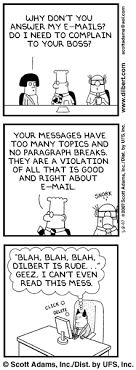
Have you ever received an email that you misunderstood? Unlike face-to-face conversation, email is very easy to misinterpret as there are no facial expressions or vocal cues to aid understanding. That is why it is important that any emails you send to customers in your role as Customer Support Specialist (CSS) are well-written and concise.

You can make your messages easier to read and understand by following a system of rules often referred to as email etiquette. In the support center, it is important that you are as comfortable communicating with customers using email as you are using the telephone.


When sending professional emails, you should:

* Use proper case: Correct usage of capitalization will make your message easier to read. In email culture, words written in uppercase are considered "SHOUTING."
* Review and check for spelling errors: Email language is usually more casual than that used in a formal letter, so it's easy to approach email communication in a somewhat sloppy manner. However, a misspelled word or the incorrect placement of a comma can change the meaning of a sentence. Most email software includes a spelling tool that checks documents for errors. You should always use this spelling tool to check your messages before sending.
* Ask the recipient's permission to send attachments: Attachments can create difficulties for email recipients. They can be incompatible with the recipient's software, as well as time-consuming to download. Also, some workplace systems place limits on the size of files that can be received.
* Send only worthwhile messages: Because email is so easy to use, users generate a large amount of unwanted email. Junk email, or spam, is annoying and time-consuming to deal with, and can also slow your server down. Most business people today are extremely busy and time-conscious. They generally do not wish to receive junk email or mail that is unrelated to their work.
* Include original messages when sending replies: Unless they are reminded of what the previous message was about, recipients can lose track of email discussions, particularly long ones.
* Make the subject line specific and eye-catching: If the subject line is specific, the recipients will have a better idea of how to prioritize your email among the many others that they receive. For example, the subject line on a reply to a customer query about software installation steps might read "Installing Software."

By following the rules for email etiquette, your messages will be more easily understood, you will save time, and the recipient will be more aware of your motivation and intentions.

It is important to practice the rules of email etiquette. The use of proper case, along with the practice of reviewing and checking for spelling, will make your email messages easier to read.

Remember to check with your recipient before sending attachments over email. Send only worthwhile attachments, include the original message with your reply, and remember to include a specific subject line. These are all valuable practices that will make your email easy to understand.

Share..
DiggIt! Del.icio.us Blinklist Yahoo Furl Technorati Simpy Spurl Reddit Fark Netscape Google

Stumble Upon Toolbar

Effective Telephone Techniques
Instructions: Use this SkillGuide to improve your non-verbal communication skills.

* Put a smile in your voice.
* React like it's your best friend on the phone.
* Start smiling before you answer the telephone.
* Think of every call as a welcome break.
* Sit up straight with both feet on the floor.
* Don't slouch.
* Treat callers with respect.
* Focus on what you can do.
* Don't take your problems out on a caller.
* Try to project a perky, positive, and upbeat image.

Share..
DiggIt! Del.icio.us Blinklist Yahoo Furl Technorati Simpy Spurl Reddit Fark Netscape Google