Showing posts with label Office Tips. Show all posts
Stumble Upon Toolbar


"Values" is a little word with big implications. Having a clear sense of your core values is a prerequisite for living in balance and in harmony with your own needs. If your life is out of balance with your values, you can't be happy. When you talk about your values, you are not talking about something that you happen to enjoy or like to do. You may enjoy music and like swimming in the ocean, but these are not values.

Your values are the things in your life that are the most important to you and that truly motivate you.

There are Five Key Value Drivers that motivate people:

  • Contributor—A contributor puts other people or an abstraction such as an organization ahead of himself.
  • Leader—A leader needs to consciously act as a model for others, setting a good example for those she works with, and believes that she can be a source of inspiration to them.
  • Winner—A winner takes great pride in personal success, accomplishments, goal setting, and planning.
  • Adventurer—An adventurer requires a lot of risk in her life. She is not happy unless she feels that she is being challenged. She finds the risk invigorating.
  • Creator—A creator expresses himself through being original. Creators like to be associated with ideas and be at the center of new developments.

You are not one thing or the other. Everyone is made up of a mixture of value drivers to some extent. But each individual has one principle, or dominant, value—this is the main motivating force for the individual. You can recognize your own main value driver by the words and phrases you use to describe what is most important to you.

Each value driver can be expressed in many ways. You may express your main value driver strongly through your job. You may also realize it through an activity, or a combination of activities, outside work.

Your values are what drive and motivate you. One of your values dominates, and your life will only feel in balance if this main driver is fully expressed. Knowing what drives you is an important step to effectively expressing yourself.

Share..
DiggIt! Del.icio.us Blinklist Yahoo Furl Technorati Simpy Spurl Reddit Fark Netscape Google

Stumble Upon Toolbar

People talk about the learning curve for acquiring a new knowledge base or skill, but most of them have never considered what this curve really looks like.

The learning process can be segmented into three stages:

  1. Set a Goal. - During the goal stage, you must establish a personal goal for increasing your sales production and earning power.

When you set your goal, aim high. Remember Napoleon Hill's words: "Anything the mind of man can conceive and believe, it can achieve."

When you set a goal, you are acting on the realization that something must change in order for you to achieve your desired end result. To achieve your goal, you may need to acquire a new knowledge base or skill set.

  1. Maintain Commitment. - As you begin the learning process, you find that you are not as effective using new strategies and skills as you were practicing your old set. The dip, or emotional pain of conscious incompetence, sets in when you realize that you have set a goal that is not easily achieved. Until dissatisfaction with the status quo exceeds the pain associated with change, it is easier to turn away from the opportunity to learn and return to your comfort zone. During this "dip" stage you must fight the urge to give up.

In the vast majority of cases, the depth of the dip in the learning curve is no more than 10 to 15 percent. In most sales situations, it takes about 90 to 120 days to reach the point where you can see yourself reaching your goal. It helps to keep this in mind.

For a period of 90 days from the time you make the conscious choice to acquire a new knowledge base or skill set, commit yourself to investing an extra ten percent of yourself into your business.

To meet the challenge and achieve your goal, give full concentration, energy, and enthusiasm to your profession during these 90 days.

Give yourself an extra half-hour to an hour daily to focus on the strategies and skills you are attempting to master.

When you have made all the calls you can make, make one more. Then make one more after that.

Set aside some time to read about and study your business. Expand your knowledge base in support of your new goals.

  1. Anticipate What To Do When Results Flatten Out. - A commitment to life-long learning means a commitment to continually looking over the horizon toward the next curve. When you realize that your results in sales production or earning power are beginning to flatten out, recognize this as the time to anticipate what needs to happen next and assess whether you need to add a new knowledge base or skill set.

If you wait too long, your business may go into decline before you begin to make the change. This can make you fall behind others in the market who have more accurately anticipated the future. Top sales professionals strive to anticipate the next growth opportunity as they become comfortable with their existing knowledge base. They know it is smart to grow from strength, as opposed to waiting until panic sets in.

Ongoing success is directly linked to continued learning. If you allow your knowledge base to become obsolete, your value in the competitive market will depreciate. You must continue to watch for upcoming trends and be ready to move along a new learning curve.

To excel in the highly competitive sales industry, you need to commit to continuous learning. To overcome the difficulties inherent in learning something new, it helps to understand the learning curve. Studying the three main stages of the learning curve can give you valuable insights. It can help you realize where you stand and what you must do in order to succeed.

NOTE: THIS POST IS APPLICABLE TO NOT JUST SALES PERSONNEL


Share..
DiggIt! Del.icio.us Blinklist Yahoo Furl Technorati Simpy Spurl Reddit Fark Netscape Google

Stumble Upon Toolbar

Personal Accountability: Working for Your Inner Boss

Instructions: Use this SkillGuide as a reference to help you construct a complete plan for proposing a contribution or accountability.

Plan Element

Definition

Your Plan

Contribution

A contribution may be something tangible such as a report, a piece of equipment, a product, or a financial gain. It may also be something intangible such as information, shared knowledge, or training for other organization members.


Metrics

A metric is a measurable standard for determining whether you succeeded or failed in implementing your proposed contribution.


Limits

Limits are boundaries that define what's included in or excluded from your contribution. Limits may describe the last step in the contribution you'll make or identify specific exclusions from your proposed contribution. If your contribution affects only some coworkers or customers, or is otherwise limited, be sure to spell out what's not included.


Share..
DiggIt! Del.icio.us Blinklist Yahoo Furl Technorati Simpy Spurl Reddit Fark Netscape Google

Stumble Upon Toolbar

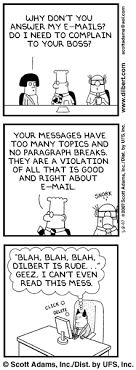
Have you ever received an email that you misunderstood? Unlike face-to-face conversation, email is very easy to misinterpret as there are no facial expressions or vocal cues to aid understanding. That is why it is important that any emails you send to customers in your role as Customer Support Specialist (CSS) are well-written and concise.

You can make your messages easier to read and understand by following a system of rules often referred to as email etiquette. In the support center, it is important that you are as comfortable communicating with customers using email as you are using the telephone.


When sending professional emails, you should:

* Use proper case: Correct usage of capitalization will make your message easier to read. In email culture, words written in uppercase are considered "SHOUTING."
* Review and check for spelling errors: Email language is usually more casual than that used in a formal letter, so it's easy to approach email communication in a somewhat sloppy manner. However, a misspelled word or the incorrect placement of a comma can change the meaning of a sentence. Most email software includes a spelling tool that checks documents for errors. You should always use this spelling tool to check your messages before sending.
* Ask the recipient's permission to send attachments: Attachments can create difficulties for email recipients. They can be incompatible with the recipient's software, as well as time-consuming to download. Also, some workplace systems place limits on the size of files that can be received.
* Send only worthwhile messages: Because email is so easy to use, users generate a large amount of unwanted email. Junk email, or spam, is annoying and time-consuming to deal with, and can also slow your server down. Most business people today are extremely busy and time-conscious. They generally do not wish to receive junk email or mail that is unrelated to their work.
* Include original messages when sending replies: Unless they are reminded of what the previous message was about, recipients can lose track of email discussions, particularly long ones.
* Make the subject line specific and eye-catching: If the subject line is specific, the recipients will have a better idea of how to prioritize your email among the many others that they receive. For example, the subject line on a reply to a customer query about software installation steps might read "Installing Software."

By following the rules for email etiquette, your messages will be more easily understood, you will save time, and the recipient will be more aware of your motivation and intentions.

It is important to practice the rules of email etiquette. The use of proper case, along with the practice of reviewing and checking for spelling, will make your email messages easier to read.

Remember to check with your recipient before sending attachments over email. Send only worthwhile attachments, include the original message with your reply, and remember to include a specific subject line. These are all valuable practices that will make your email easy to understand.

Share..
DiggIt! Del.icio.us Blinklist Yahoo Furl Technorati Simpy Spurl Reddit Fark Netscape Google